The Blockade That Cuts Cuba’s Lifeline
On April 14, 2026, U.S. Central Command began enforcing a naval blockade of Iranian ports. Over 10,000 personnel, more than a dozen warships, and dozens of aircraft are now preventing any vessel from entering or leaving Iranian coastal waters. In the first 24 hours, six merchant ships were turned back. Zero breaches reported.
The official story is about Iran’s nuclear program and regional security. But there’s a second story here — one that hits closer to home for anyone who cares about Cuba’s strategic position in the Western Hemisphere.
Iran has been one of Cuba’s last remaining economic lifelines. And that lifeline just got severed.
Cuba’s Chain of Sugar Daddies
My dad’s family knows this pattern better than anyone. Cuba has always survived by latching onto a powerful benefactor. First it was Spain. Then the Soviet Union poured billions into the island for three decades. When the USSR collapsed in 1991, Cuba entered the “Special Period” — people lost 20 pounds, ate whatever they could find, and rode bicycles because there was no fuel.
Then Hugo Chávez stepped in. Venezuela shipped billions in subsidized oil to Cuba in exchange for doctors and military advisors. That kept the regime alive through the 2000s and 2010s — until Venezuela’s own collapse cut that lifeline.
When Venezuela cratered, Cuba turned to Iran.
Iran and Cuba: The Alliance You Didn’t Know About
This isn’t speculation. Iran and Cuba have had a formal strategic alliance since the early 2000s. Iran has invested in Cuban infrastructure, provided technology support, and — critically — facilitated trade routes that bypass U.S. sanctions.
Cuba imports over $2 billion annually in goods, much of it through allied shipping channels. Iran has been one of the key nodes in that supply chain. Oil, medicine, manufactured goods, military equipment — if it came from an ally willing to defy the U.S., Iran was often the middleman.
We covered Iran’s own internal crisis just weeks ago. The regime was already crumbling from within. Now the U.S. is squeezing from the outside.
What the Blockade Actually Does
CENTCOM’s statement was clear: the blockade applies to “vessels of all nations entering or departing Iranian ports and coastal areas.” Freedom of navigation remains in place for ships transiting the Strait of Hormuz to non-Iranian destinations — but anything touching an Iranian port gets stopped.
Six merchant ships turned around in 24 hours. That means six cargoes that were supposed to reach someone didn’t. Multiply that by weeks and months, and you’re looking at a supply chain collapse.
For Cuba, this means:
- Oil shipments that transit through Iranian-controlled channels get cut off
- Medical supplies that Cuba imports through third-party deals dry up
- Military equipment that Iran has been providing stops arriving
- Hard currency from re-exporting Iranian goods disappears
The Domino Effect
Cuba’s regime doesn’t just depend on Iran for trade — it depends on Iran for legitimacy. As long as Cuba could point to Tehran, Moscow, or Beijing and say “we have allies,” the government could justify its existence to the Cuban people.
Take away the shipping lanes and what’s left?
Russia already tested America’s Cuba blockade — and lost. China is playing a long game and won’t risk a direct confrontation over Cuban imports. Venezuela’s regime is barely standing after Maduro’s fall.
The blockade of Iranian ports doesn’t just cut off goods. It cuts off Cuba’s last excuse.
What Happens Next
I’ve seen this movie before. When Cuba’s benefactors disappear, two things happen simultaneously:
- The regime doubles down on repression — because they know they’re vulnerable and can’t show weakness
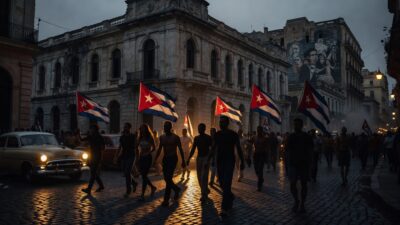
- The people take to the streets — because hunger is the one thing that overcomes fear
We saw both in July 2021 and beyond. Each time, the regime survived — barely. But each time, they had less to offer the people. Cuba’s collapse is not a question of if, but when.
If the Iranian blockade holds — and CENTCOM says it’s holding — Cuba’s economic situation goes from bad to catastrophic within months. Not years. Months.
The Question Nobody’s Asking
The media is focused on what the blockade means for Iran’s nuclear program. Fair enough. But the second-order effects are just as significant.
What happens to Cuba when Iran can’t ship? What happens to Venezuela when its last major ally is cut off? What happens to Nicaragua when the entire socialist bloc is financially strangulated?
The blockade isn’t just about Tehran. It’s about every regime in the Western Hemisphere that’s been hiding behind Iran’s coattails.
My dad’s family didn’t flee Cuba just to watch another generation suffer under the same lies. But watching this blockade unfold, I can’t help but think: maybe — just maybe — the lifeline that was keeping these regimes alive just got severed.
And maybe that’s exactly what needed to happen.
— Jonathan A.
Frequently Asked Questions
Why does the Iran blockade affect Cuba?
Cuba imports over $2 billion annually in goods from allied nations. Iran has been a key trade partner, facilitating oil shipments, medical supplies, and military equipment through routes that bypass U.S. sanctions. When Iranian ports are blockaded, those supply chains are cut off — directly impacting Cuba’s ability to import essential goods.
Has Cuba always depended on foreign benefactors?
Yes. Cuba’s economic model has always relied on a powerful patron. From Spain in the colonial era, to the Soviet Union (1960-1991), to Venezuela under Chávez (2000s-2010s), and most recently Iran. Each time a benefactor collapses, Cuba enters a severe economic crisis — most notably the “Special Period” after the Soviet Union fell.
What is CENTCOM’s role in the blockade?
U.S. Central Command (CENTCOM) is enforcing the blockade with over 10,000 personnel, 12+ warships, and dozens of aircraft across the Arabian Gulf and Gulf of Oman. The blockade prevents any vessel from entering or departing Iranian ports while maintaining freedom of navigation for ships transiting to non-Iranian destinations through the Strait of Hormuz.
Could the blockade lead to regime change in Cuba?
Not directly — the blockade targets Iran, not Cuba. But by cutting off one of Cuba’s last economic lifelines, it accelerates the regime’s financial collapse. History shows that when Cuba loses a benefactor (USSR in 1991, Venezuela in the 2010s), economic desperation leads to civil unrest and increased repression. The blockade makes Cuba’s situation more precarious without any direct action against Havana.
What other countries are affected by the Iran blockade besides Cuba?
Venezuela, which has relied on Iranian oil and technology partnerships, will also feel the impact. Nicaragua under Ortega, which has received Iranian support, faces similar supply chain disruptions. The broader “socialist bloc” in Latin America — Cuba, Venezuela, and Nicaragua — all depended partly on Iran’s willingness to trade outside U.S. sanctions.