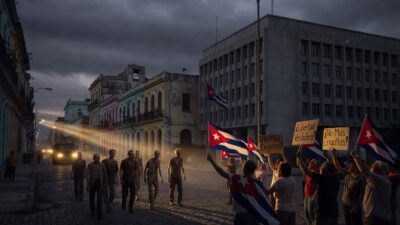
TL;DR: This week in Latin America, Cuba stayed trapped between regime stubbornness and a deepening energy crisis, Venezuela pushed hard to reopen for business after Maduro’s removal, Nicaragua remained the clearest example of family dictatorship in the region, and Washington showed that Trump’s Latin America policy is no longer rhetorical. My dad fled Cuba. My mom fled Nicaragua. So when I watch the region this week, I do not see abstract foreign policy. I see the same old socialist machinery trying to survive by squeezing ordinary people harder while the United States tests how far it is willing to go to force change.
Week in Review: The Old Regimes Are Cornered, but Not Finished
If you wanted one headline for the week, it would be this: every major story in Cuba, Venezuela, and Nicaragua was about pressure. Pressure on failing systems. Pressure from Washington. Pressure on families who have already paid too much for socialist vanity projects and police-state control.
That is why this week matters. The region is not moving in one direction. Cuba is trying to survive on emergency fuel and repression. Venezuela is trying to rebrand itself as open for energy and investment under Delcy Rodríguez. Nicaragua is still doubling down on dynastic dictatorship and political punishment. And in Washington, the Senate made clear that even when some lawmakers want limits, Trump still has broad political room to keep squeezing hostile regimes in the hemisphere.
For readers trying to make sense of the noise, this is consideration-stage news: not every headline matters equally. The stories below are the ones that actually shaped the week.
Cuba: A Regime Running on Fumes and Threats
Cuba had the most morally revealing week of the bunch. The humanitarian situation remains ugly, and the political class in Havana still acts like coercion is a substitute for legitimacy.
First, the energy crisis did not disappear. Reuters reported last week that Russian oil deliveries gave Cuba only short-term relief after severe fuel shortages helped trigger nationwide blackouts and flight disruptions. That matters because it confirms the regime is not solving the underlying problem. It is borrowing time. A tanker can ease panic for a few days. It cannot fix an economic model built on dependency, fear, and state failure.
AP then showed what that crisis looks like on the ground. In its report on Cuban farmers, the outlet described equipment falling silent for lack of fuel, crops going to waste, and hunger deepening as production gets harder. That is the socialist pattern my father’s generation already understood: the people who grow food are trapped by a political system that cannot even keep diesel flowing.
At the same time, the diplomatic temperature rose again. AP reported that Cuba’s U.N. ambassador denied that Havana was discussing the release of political prisoners as part of talks with the United States. Al Jazeera also reported that Cuba confirmed talks with U.S. officials while demanding an end to Trump’s energy blockade. Put those together and the picture is blunt: the regime still wants relief without real accountability.
Then came the week’s biggest Washington-Cuba headline. The U.S. Senate rejected an effort to restrain Trump from taking military action against Cuba without congressional approval, according to both AP and Reuters. Al Jazeera’s summary of the debate highlighted Senator Tim Kaine’s argument that blocking fuel shipments already amounts to a form of hostilities. Whether you agree with Kaine’s framing or not, the political takeaway is bigger: Havana now knows there is no easy assumption that Washington will self-limit.
For Luna readers, this is where family history matters. My dad did not flee Cuba because socialism was inefficient. He fled because it turns ordinary scarcity into a permanent system of control. This week’s Cuba news was another reminder that the regime still treats suffering as a management tool.
If you want more background on that pattern, revisit Trump’s Hammer: Crushing Cuba’s Communist Regime, Trump, Rubio and the ‘Friendly Takeover’: What’s Happening in Cuba Right Now, and Cuba 2026: Is the Díaz-Canel Regime on the Brink of Collapse?.
Venezuela: Opening the Doors While the Power Structure Holds
Venezuela’s week was less about humanitarian collapse and more about accelerated repositioning. The message from Caracas was clear: the post-Maduro order wants money, energy deals, and international normalization fast.
Reuters reported that companies are pulling oil rigs out of storage as contracts are revised to boost production, with the government reportedly targeting stronger output by year-end. Reuters also reported that BP signed an agreement tied to offshore gas development. Those are not minor technical stories. They are signs that Venezuela’s leadership wants to turn political transition into an energy reset.
AP added two more important developments. First, Delcy Rodríguez visited Barbados seeking oil and gas investment, explicitly inviting Caribbean partners into Venezuela’s energy future. Second, the first direct commercial U.S.-Venezuela flight in seven years landed in Caracas, a symbolic marker that normalization is no longer theoretical.
There was also a geopolitical layer. Reuters and AP both highlighted high-level talks between Colombia and Venezuela, including cooperation on trade, security, and energy. In other words, Caracas is trying to lock in regional relationships while its new external opening is still fresh.
That creates both opportunity and danger. Opportunity, because Venezuelans desperately need economic breathing room after years of socialist disaster. Danger, because a market reopening without real institutional reform can simply become a cleaner-looking version of elite control. Socialism often mutates before it dies. It learns to wear a tie and talk about investment.
For context, Luna readers should revisit Venezuela: The Maduro Dictatorship and Why the World Must Act and Can Venezuela Recover? Why 2026 Could Mark the End of Chavismo’s Economic Ruin.
Nicaragua: Ortega’s Family Dictatorship Tightens Its Grip
Nicaragua had fewer splashy headlines this week, but the underlying story may be the darkest of all: Ortega and Murillo are still building a family-run state that punishes dissent by attacking citizenship, property, and memory itself.
AP reported that the U.S. Treasury sanctioned two sons of Daniel Ortega and Rosario Murillo, along with officials and firms tied to the gold sector. Reuters separately reported U.S. actions against officials linked to the gold industry and the seizure of a company with U.S. investment, plus visa sanctions on Interior Vice Minister Luis Roberto Cañas Novoa over alleged abuses.
That should not be read as routine sanctions housekeeping. It is recognition that the regime’s repression is not just ideological. It is commercial, familial, and institutional. The Ortega-Murillo machine uses state power to reward loyalists, punish enemies, and make the ruling family unavoidable.
Meanwhile, El País published a devastating account of Nicaragua’s stateless exiles, noting that Spain has granted nationality to more than 135 Nicaraguans while hundreds have been stripped of citizenship by the regime. My mom fled Nicaragua, so this one lands differently for me. Stripping people of nationality is not just bureaucratic cruelty. It is a regime saying: if you oppose us, we will try to erase your belonging altogether.
If you have been following Luna, you already know this is not new. See Nicaragua 2026: Ortega’s Nightmare and Latin America’s Freedom Crisis and Ortega’s Brutal Betrayal: How Nicaragua Erases Its Own People.
U.S. Latin America Policy: Trump Still Has Room to Escalate
The biggest policy takeaway this week is that Trump’s posture toward Latin America’s leftist regimes still has political momentum, especially when framed as anti-socialist pressure and regional security.
The Cuba Senate vote mattered not just for Havana, but for the entire hemisphere. AP described it as another sign that Republicans continue to back Trump as he acts forcefully across multiple conflicts, including Cuba and Venezuela. The Hill also reported that senators from both parties are pressuring Trump to counter China’s influence in Latin America. That is a reminder that even when the methods are debated, the broader strategic consensus in Washington is moving toward more assertive engagement in the region, not less.
From a conservative perspective, that is overdue. For too long, U.S. policy treated Latin America as a background issue unless a migrant surge, cartel crisis, or energy shock forced attention. This week showed what happens when the region is treated as strategically central again. Cuba, Venezuela, and Nicaragua all felt the pressure in different ways.
Weekly Comparison Table
| Country / Arena | Big Story This Week | Why It Matters | Direction of Travel |
|---|---|---|---|
| Cuba | Fuel crisis persisted, farmers reported worsening shortages, and the U.S. Senate refused to restrict Trump on Cuba. | The regime remains fragile, dependent, and unwilling to trade relief for real political concessions. | More pressure, more scarcity, more uncertainty. |
| Venezuela | Energy deals expanded, foreign investment outreach intensified, and direct U.S. flights resumed. | Caracas is moving fast to normalize business ties and recast itself after Maduro. | Rapid reopening, but institutional questions remain. |
| Nicaragua | U.S. sanctions hit Ortega-linked figures while attention returned to stateless exiles. | The regime is still tightening family control and criminalizing dissent at the identity level. | Hardening dictatorship with deeper international scrutiny. |
| U.S. Policy | Senate Republicans backed Trump’s flexibility on Cuba as bipartisan concern about Latin America strategy persisted. | Washington is signaling that pressure on hostile regimes remains on the table. | Assertive hemisphere policy, with escalation risk intact. |
What to Watch Next Week
Three things deserve attention next week.
- Cuba’s fuel supply: If emergency shipments do not stabilize transport and agriculture, expect more visible social strain and louder regime paranoia.
- Venezuela’s normalization terms: Watch whether new deals bring broader reform or simply enrich the same networks under a different political banner.
- Nicaragua sanctions follow-through: The real question is whether Washington keeps climbing the Ortega family tree or settles for symbolic pressure.
And on the U.S. side, the main question is whether the administration treats this week’s Senate backing as a green light for even more aggressive regional action.
FAQ
What was the biggest Latin America story of the week?
The Senate vote on Trump and Cuba was the clearest strategic headline, because it affected the regional balance and signaled that pressure on Havana still has political support in Washington.
Why was Cuba still the moral center of the week?
Because the energy crisis keeps exposing what communism always does: it turns daily life into dependence while demanding obedience from people who are already exhausted.
Is Venezuela improving?
Economically, it may be opening faster than many expected. Politically, the answer is less clear. A reopening is not the same thing as a free republic.
Why does Nicaragua matter if it gets less media attention?
Because Ortega’s model is one of the most explicit family dictatorships in the hemisphere. It shows what happens when the state becomes a private inheritance project.
Why do you write about this so personally?
Because for me this is family history, not armchair ideology. My dad fled Cuba. My mom fled Nicaragua. I grew up hearing what socialism destroys long before I ever wrote about politics.