TL;DR: This week’s biggest Latin America story was not a single headline. It was a pattern. Cuba kept lurching from blackout to blackout while even its Russian fuel lifeline looked shaky. Venezuela tried to sell a reopening story while prison abuses reminded everyone that power has not really become accountable. Nicaragua’s dictatorship kept tightening the screws on the Church and on basic human dignity. And in Washington, the Trump administration signaled that pressure on the hemisphere is getting more organized, not less. My dad fled Cuba. My mom fled Nicaragua. So I do not read these stories as abstractions. I read them as another week of socialism proving that it always asks ordinary people to absorb the cost of elite failure.
Week in Review: The Hemisphere’s Old Ghosts Are Still Running the Script
If you stepped away from Latin America for a few days, here is the simplest way to understand the week: the region’s left-wing strongholds are still trying to survive the consequences of their own systems, while Washington is testing how aggressively it wants to shape what comes next.
The five biggest developments of the week were these: Cuba’s fuel crisis stayed front and center; the U.S. political class showed little appetite to restrain Trump on Cuba; Venezuela’s prison system delivered another brutal reminder that economic normalization is not the same thing as justice; Nicaragua’s war on the Catholic Church kept deepening; and the White House rolled out a harder-edged drug strategy that puts more pressure on Latin American governments.
That matters because readers do not need more noise. They need a map. If you want the prequel to this week, go back to last week’s Luna wrap. If you want the sharper country-level background, Luna has already been tracking Cuba’s unraveling, Venezuela after Maduro, Ortega’s constitutional crackdown, and Trump’s broader hemispheric counteroffensive.
Cuba: Running on Fumes, Not Reform
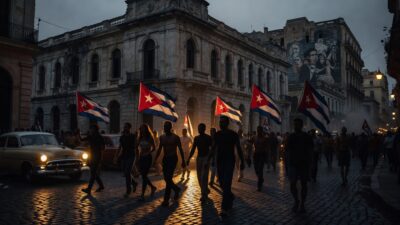
Cuba again felt like the moral center of the week, because the regime’s crisis remains the clearest picture of what socialist decay actually looks like in real life. Not theory. Not campus slogans. Blackouts, shortages, fear, and a government that still acts as if survival is a substitute for legitimacy.
The most important Cuba development this week was that the island’s energy relief still looked painfully fragile. Bloomberg reported on May 5 that a tanker carrying Russian fuel appeared stalled offshore, dealing a fresh blow to an island already facing its worst fuel crunch in decades. That story landed hard because Reuters had already explained that recent Russian deliveries only offered short-term relief, not a structural fix. BBC coverage of the earlier Russian tanker arrival made the same point in plain language: one shipment can buy time, but not solve the regime’s deeper failure.
Al Jazeera’s reporting underscored how thin that buffer really is, noting that the Russian tanker that reached Cuba earlier this cycle could cover only about nine or 10 days of diesel demand. That is not resilience. That is a state living shipment to shipment.
The second big Cuba story was political. AP reported that Senate Republicans rejected legislation that would have forced Trump to end the energy blockade absent congressional approval. Another AP report this week said the U.S. is not looking at imminent military action against Havana, but the political message to Cuba was still unmistakable: Washington is not in a hurry to give the regime breathing room on easy terms.
That is why I think the most revealing Cuba story this week was not really about a ship or a Senate vote by itself. It was about dependence. My dad’s family did not leave Cuba because communism was merely inefficient. They left because it turns scarcity into a governing tool. When fuel, medicine, and food become conditional, the state does not just fail. It disciplines.
On X, the mood around Cuba this week reflected that same exhaustion. The posts that circulated most were about the stalled Russian tanker and the island’s inability to escape permanent emergency mode, not about any believable reform path. If you want Luna’s deeper background on that trap, read Trump’s New Cuba Sanctions Are Not ‘Cruel’ — They’re What an Honest Policy Looks Like and Cuba’s Breaking Point: How Blackouts Spark a Revolution Against Communism.
Venezuela: Reopening Optics, Prison-State Reality
Venezuela’s week carried a different kind of warning. The headline energy for months has been about reopening, investment, and what comes after Maduro. But this week showed why that narrative still needs a giant asterisk.
The sharpest story came from Reuters, which reported on May 8 that Venezuela confirmed the death of a detainee whose 82-year-old mother had spent more than a year searching for him. The moral obscenity of that story is not subtle. A government that can sit on a prisoner’s death while a mother searches in desperation is telling you exactly how much institutional reform has really happened.
El País added more context with its reporting on the Yare III prison riot that left five inmates dead. The article described families demanding proof of life, human-rights groups warning of systematic neglect, and prison conditions that former detainees openly describe as torture. That matters because every glossy “Venezuela is back open for business” headline should be measured against whether the people running the system are actually accountable to law.
At the same time, the reopening campaign did not stop. AP reported that Delcy Rodríguez visited Barbados seeking oil and gas investment, explicitly pitching Venezuela as a new energy partner. Reuters also reported in late April that BP signed an agreement tied to offshore gas exploration, another sign that the country’s leadership wants to turn transition into commercial momentum quickly.
That is the tension in Venezuela right now. There is real movement. There is also real continuity. Capital may come back faster than liberty does. Bureaucrats may swap rhetoric faster than prisons change character. On X, that split was obvious this week too: investment chatter and diplomatic optimism kept colliding with rights advocates still circulating political-prisoner counts and prison-abuse warnings.
For Luna readers, that is why Maduro’s Fall: How America Reclaimed Latin Freedom should not be read as a victory lap alone. Venezuela may be post-Maduro, but it is not yet post-impunity.
Nicaragua: Ortega and Murillo Keep Waging War on Faith and Fearlessness
Nicaragua did not generate the flashiest headlines of the week, but it may have produced the clearest reminder that socialism in Latin America often ends as family dictatorship.
The most important Nicaragua reporting I found this week came from Catholic World Report, which published a detailed account from a priest serving in Nicaragua who said police photograph him every Sunday, track his movements, and make clear that speaking about social realities can mean prison or exile. The details matter: clergy forced to report parish travel, bishops monitored, processions restricted, and a whole Church pushed into a state of nervous semi-silence.
Breitbart also reported this week that Rosario Murillo attacked priests as “servants of Satan”. You do not have to share Breitbart’s style to recognize the underlying reality: the Ortega-Murillo regime still treats independent moral authority as a threat. For broader context, AP has documented how Nicaragua’s crackdown on the Catholic Church has worsened, and how the regime’s broader constitutional changes have concentrated power inside the ruling family.
This is the part that gets personal for me. My mom fled Nicaragua. So when I read about priests monitored like suspects and believers pushed into survival mode, I do not see an isolated church-state dispute. I see what happens when a regime cannot tolerate any institution it does not own.
Luna has been covering that pattern directly. If you missed them, read Ortega’s Constitutional Coup: How Nicaragua Erases Its Own People and Ortega’s Nicaragua: How Socialism Destroys Democracy. This week did not contradict those warnings. It confirmed them.
U.S. Latin America Policy: Pressure Is Getting More Structured
The week’s biggest Washington takeaway was that Trump’s Latin America posture is becoming more systematized. It is not just about one-off threats anymore. It is becoming paperwork, strategy, and sustained pressure.
The White House announced the release of the 2026 National Drug Control Strategy, framing it as a roadmap to dismantle supply chains and intensify the fight against illicit drugs. El País then broke down what that means for the hemisphere, reporting that Mexico and Colombia are explicitly being pushed toward tougher and more measurable anti-drug performance, with Washington willing to use diplomatic, economic, and security tools more aggressively.
That article matters beyond Mexico and Colombia because it tells you how this White House sees the hemisphere: not as a side theater, but as a security arena tied to fentanyl, migration, cartels, China, energy, and state weakness. That is also why the Cuba Senate fight matters. Even when Washington avoids immediate escalation, the infrastructure of pressure is getting stronger.
I think that is the real regional headline of the week. Cuba, Venezuela, and Nicaragua are different cases, but they all now face a U.S. posture that is more willing to use leverage and less interested in therapeutic language about coexistence. Whether that becomes a serious freedom strategy or just a louder version of selective pressure is still an open question.
Weekly Comparison Table
| Country / Arena | Biggest Development This Week | Why It Matters | What It Signals |
|---|---|---|---|
| Cuba | Fuel shortages stayed severe and even Russian relief looked unstable. | The regime is still living shipment to shipment, not reform to reform. | More dependency, more blackouts, more brittle control. |
| Venezuela | Prison abuse stories cut against the reopening narrative. | Economic normalization is happening faster than institutional accountability. | A marketable reset without full moral reset. |
| Nicaragua | Church persecution remained intense and openly ideological. | The Ortega-Murillo family still sees independent faith as political competition. | Hardening family dictatorship. |
| U.S. Policy | Washington rolled out a tougher regional drug strategy and kept pressure tools intact. | The hemisphere is being folded into a broader security doctrine. | More structured pressure from the United States. |
What to Watch Next Week
Next week, I would watch four things.
- Cuba’s fuel cushion: If deliveries stay delayed or inadequate, blackouts and transport problems will keep exposing how thin the regime’s margin really is.
- Venezuela’s accountability gap: If investment headlines keep coming while prison stories keep surfacing, that contradiction will define the country’s credibility problem.
- Nicaragua’s church crackdown: The key question is whether the regime escalates from surveillance and intimidation into another public example meant to terrorize clergy.
- U.S. follow-through: Strategies and statements are one thing. Whether Washington turns them into consistent policy across the hemisphere is the real test.
FAQ
What was the single biggest Latin America story this week?
If I had to pick one, it was the combination of Cuba’s worsening fuel fragility and Washington’s unwillingness to ease pressure quickly. That combination still shapes the whole regional conversation.
Why focus so much on Cuba?
Because Cuba remains the clearest case study in how socialism degrades daily life while pretending to defend dignity. My dad’s family knew that long before it was fashionable to talk about “failed systems.”
Is Venezuela actually improving?
Parts of it may be reopening economically, yes. But prison abuse, opaque power structures, and weak accountability are reminders that a reopening is not the same thing as a free republic.
Why does Nicaragua matter if it gets less coverage?
Because Nicaragua shows the end stage of ideological rule: a family regime that attacks citizenship, religion, and dissent all at once.
What is the main U.S. policy trend to watch?
Washington is moving toward more organized pressure in the hemisphere, especially where drugs, cartels, hostile regimes, and geopolitical competition overlap.