TLDR
Cuba’s national power grid has collapsed — again. As of April 13, 2026, 55% of the island sits in simultaneous darkness, with blackouts reaching a deficit of 1,630 MW during peak hours. Hospitals are evacuating ICU patients. The UN says 2 million Cubans face a “severe humanitarian crisis,” with 96,000 surgeries pending — including 11,000 on children. The regime’s response? Threatening life imprisonment or the death penalty for anyone who damages the electrical grid. Welcome to the paradise that American academics romanticize from their air-conditioned offices.
55% of Cuba Went Dark Last Night
Let me paint the picture for you, because numbers alone don’t capture what 1.6 gigawatts of missing power actually means when you’re the one sitting in it.
On Sunday, April 13, Cuba’s Electric Union — the state-run entity responsible for keeping the lights on — issued what has become a grim daily ritual: the morning blackout forecast. The numbers were catastrophic. Available capacity: 1,350 MW. Peak demand: 2,950 MW. That’s a shortfall of 1,600 megawatts, enough to leave more than half the country without electricity simultaneously during nighttime hours. According to EFE, this means 55% of Cuba’s national territory plunged into darkness at the same time.
This isn’t an anomaly. This is Tuesday. This is every day.
Just two weeks ago, on April 7, the Antonio Guiteras thermoelectric plant — one of Cuba’s most critical power generation facilities — suffered a boiler malfunction and went offline. Blackouts immediately surged to nearly 1,900 MW. On April 1, the peak hit 1,945 MW. On March 16, the entire national grid disconnected for 29 hours and 29 minutes — every single light on the island, extinguished.
As I write this on April 13, multiple generating units remain down: Unit 1 at the Ernesto Guevara plant, Unit 5 at the Antonio Maceo plant, Unit 2 at the Felton plant, plus additional units under maintenance at Mariel, Renté, and Nuevitas. That’s 373 MW of thermal generation simply gone.
The only relief? Cuba’s 54 solar parks produced 3,825 MWh on Saturday with a peak of 526 MW — but only at noon. When the sun sets and the real blackouts hit, solar contributes exactly zero.
Hospitals Are Evacuating Patients from ICUs
Here’s where the story stops being about energy policy and starts being about human lives.
On this very Sunday — the same day I’m writing this — a blackout at the Saturnino Lora Provincial Hospital in Santiago de Cuba forced the evacuation of 12 to 14 patients from the Intensive Care Unit. Not planned transfers. Emergency evacuations. Because the power went out in a hospital’s ICU. Even the regime’s own state press confirmed it.
The UN has warned that at least 2 million people in Cuba are facing a severe humanitarian crisis. More than 96,000 surgeries are pending, including 11,000 on children. Cuban health officials have acknowledged that the crisis has increased mortality risk for cancer patients, especially pediatric ones. In Havana, residents line up at water tank trucks because the combination of fuel shortages and grid instability has left thousands of taps dry.
This is not an embargo problem. This is a systemic failure that has been building for 67 years of communist mismanagement.
The Regime’s Response: Threaten Its Own People
Facing the worst energy crisis in Cuba’s modern history, with hospitals evacuating ICU patients and children dying on surgical waitlists, what did the communist government do?
Did it open the economy? Invite foreign investment in the grid? Accept help from the international community?
No. On Saturday, government presenter Humberto López appeared on state television and threatened life imprisonment or the death penalty for anyone who damages the electrical system.
Read that again. The lights are off. The hospitals are failing. Children can’t get surgery. And the regime’s message to 10 million suffering Cubans is: Touch our crumbling infrastructure and we’ll kill you.
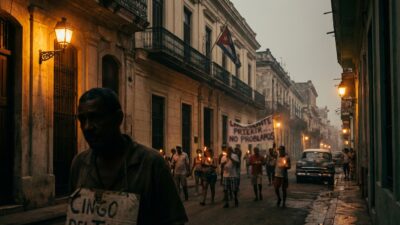
Meanwhile, in La Güinera, a neighborhood in Havana, residents responded the only way desperate people can — with a cacerolazo. Pots and pans banging in the darkness. The sound of people who have nothing left to lose. It’s the same sound my dad’s family heard in Havana before they fled. The same sound my mom’s family heard in Managua. The pots and pans always come before the collapse.
Why the Grid Is Collapsing: A Timeline
Cuba’s power grid was never built to last. It runs on obsolete Soviet-era thermal plants that consume fuel oil and diesel — and thermoelectric plants alone use twice as much fuel as every other sector on the island combined. When the oil stops flowing, the lights go out. Period.
| Date | Event | Impact |
|---|---|---|
| January 2026 | US captures Maduro; Venezuela oil shipments stop | Cuba loses 70,000 barrels/day |
| February 2026 | US blocks oil tankers heading to Cuba, threatens sanctions on exporters | First effective US blockade since 1962 Missile Crisis |
| February 2026 | Mexico halts Pemex shipments under US tariff pressure | Cuba loses its second-largest oil supplier |
| March 4 | Guiteras plant shutdown causes western Cuba blackout | Millions lose power |
| March 16 | Total national grid collapse | 29 hours 29 minutes of total blackout |
| March 30 | Russian tanker delivers 700,000 barrels of crude | Enough for 7-10 days |
| April 1 | Peak blackout hits 1,945 MW | Worst day of 2026 so far |
| April 7 | Guiteras boiler malfunction | Blackouts surge to 1,871 MW |
| April 13 | 55% of national territory simultaneously dark | ICU patients evacuated in Santiago |
The Russian oil delivery on March 30 was a band-aid on a bullet wound. Reuters reported that the 700,000 barrels — roughly 100,000 tonnes — would last Cuba between 7 and 10 days. That supply ran out in mid-April. We’re now past that deadline, and there’s no replacement coming. Russia has its own problems. China isn’t sending tankers into a US naval blockade.
The Venezuela Connection: Cuba’s Lifeline Was Always a Lie
For decades, apologists for the Cuban regime pointed to the island’s healthcare system and social programs as proof that socialism “works.” What they never mentioned was that Cuba’s entire model was subsidized by Venezuelan oil.
When Fidel Castro and Hugo Chávez declared their nations “a single nation” — “Venecubans” — it wasn’t just rhetoric. Venezuela provided Cuba with approximately 70,000 barrels of crude oil per day and refined products worth about $1.3 billion annually. In exchange, Cuba sent thousands of doctors, intelligence operatives, and military advisors to Caracas. It was a transactional relationship dressed up in revolutionary language.
When Maduro fell in January 2026, that lifeline was severed overnight. Cuba went from having a guaranteed oil supplier to having zero reliable sources of fuel in less than a month. Mexico caved to US tariff threats. Russia offered a token shipment. And 10 million Cubans paid the price.
This is the part that makes my blood boil when I hear people talk about Cuba’s “resilience” or its “sovereign right” to choose socialism. Cuba didn’t choose socialism. A dictator with a gun chose it for them in 1959. And the only reason it lasted this long was because Venezuela — another socialist disaster — was footing the bill.
Trump’s Pressure Strategy: Brutal but Effective
Let me be honest about something. I’m not going to pretend the US oil blockade is painless. It’s not. Real people — my people, Cuban people — are suffering because of it. My father’s family knows what it’s like to sit in the dark wondering when the lights will come back on.
But I also know this: 67 years of diplomacy didn’t free Cuba. Obama’s “thaw” didn’t free Cuba. The UN’s annual vote condemning the embargo — 184 to 2 — didn’t free Cuba. What’s actually squeezing the regime is what’s happening right now: the economic pressure is so intense that Díaz-Canel has been forced to the negotiating table for the first time.
On March 13, Díaz-Canel publicly confirmed his government was in talks with the United States. He released over 2,000 prisoners on April 3. He opened Cuba to exile investment. He talked about “fluid commercial relationships with US companies.” These are concessions a communist regime never makes voluntarily. They make them when they’re staring into the abyss.
Trump said it plainly on March 16: “Cuba is seeing the end.” Whether that end comes through negotiation or collapse remains to be seen. But for the first time in my lifetime, it’s actually happening.
The Protesters Are Back — And the Regime Is Terrified
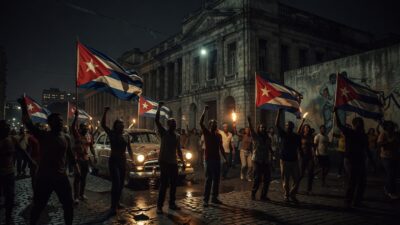
On March 14, anti-government protesters attacked a Communist Party office in central Cuba. On April 11, La Güinera erupted in cacerolazos. These aren’t isolated incidents. They’re echoes of July 11, 2021 — the largest protests Cuba had seen in decades — happening in a country that’s now in far worse shape than it was then.
The regime knows this. That’s why Humberto López is on television threatening to execute people. That’s why Díaz-Canel projects defiance while quietly negotiating with Washington. That’s why the Castro family — yes, they’re still pulling strings behind the scenes — has moved to reassert control. They know the pots and pans are coming. They know they can’t keep the lights on. And they know that when a communist regime can’t provide electricity, it can’t provide anything — not food, not medicine, not stability.
The Castro dynasty survived the fall of the Soviet Union by the skin of its teeth during the “Special Period.” It survived the 2021 protests by arresting everyone in sight. But it has never faced something like this: total energy collapse with no lifeline, no patron state, and an American president who actually wants to finish the job.
What Comes Next
I don’t have a crystal ball. But I know what my dad told me about Cuba in the 1960s, and what my mom told me about Nicaragua under the Sandinistas: communist regimes don’t fall gradually. They hold on, hold on, hold on — and then they fall all at once.
Cuba is closer to that moment than it has been at any point since 1959. The grid is failing. The hospitals are failing. The Russian oil is gone. Mexico won’t send fuel. Venezuela can’t send fuel. China won’t risk a confrontation with Washington over a Caribbean island. And 10 million Cubans — people who just want the lights to come on and their kids to get surgery — are sitting in the dark listening to their government threaten to execute them for complaining about it.
That’s not resilience. That’s a hostage situation.
FAQ
Why is Cuba’s power grid collapsing?
Cuba’s grid runs on obsolete Soviet-era thermal plants that depend entirely on imported oil and diesel. Since January 2026, the US has blockaded oil shipments to Cuba — Venezuela’s supply was cut after Maduro’s capture, Mexico halted exports under US pressure, and Russia’s single March delivery lasted only 7-10 days. Without fuel, thermoelectric plants cannot generate power.
How many hours a day do Cubans experience blackouts?
Most Cubans, including those in Havana, were already experiencing 16+ hours of daily blackouts before the most recent grid collapses. As of April 2026, entire provinces regularly go without power for 20+ hours per day, and total national grid failures have lasted nearly 30 hours.
Is the US oil blockade legal?
The US maintains it’s enforcing the existing embargo (in place since 1962) and existing sanctions. Critics, including the UN General Assembly (which votes 184-2 annually to condemn the embargo), argue the blockade violates international law. The maritime interdiction of oil tankers has been compared to a naval blockade, though the US doesn’t use that term.
What has Cuba done to address the crisis?
Díaz-Canel confirmed diplomatic talks with the US on March 13. Cuba released over 2,000 prisoners on April 3, opened the country to exile investment, and expressed willingness to build “fluid commercial relationships” with US companies. However, the regime has also threatened citizens with life imprisonment or death for damaging electrical infrastructure.
How does Cuba’s crisis compare to Venezuela’s?
Venezuela’s crisis under Maduro resulted in hyperinflation, mass migration (7+ million people), and eventual regime collapse through US military intervention in January 2026. Cuba’s crisis is different — more cohesive regime structure, no narco-state element, but potentially more devastating because Cuba’s economy is almost entirely dependent on oil imports with zero domestic alternatives.
Could Cuba turn to renewable energy to solve the crisis?
Cuba has 54 solar parks that produce some daytime power (peak 526 MW), but they contribute zero during nighttime peak demand hours when blackouts are worst. Experts say stabilizing Cuba’s grid would require billions of dollars of investment over several years — money the regime doesn’t have and can’t attract while maintaining its socialist economic model.
Sources: Reuters · TIME · Cibercuba · BBC · New York Times · UN News