The Díaz-Canel regime is facing its deepest crisis since he took power. This isn’t rhetoric — these are numbers, facts, and a population that simply can’t take it anymore.
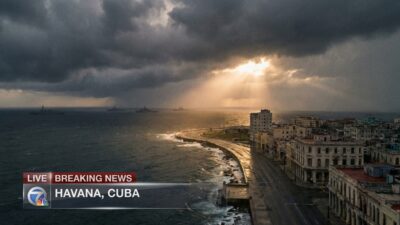
In March 2026, Cuba is living through an unprecedented energy collapse. The oil blockade imposed by the Trump administration has cut off the flow of Venezuelan crude that kept the island functioning — badly, but functioning. Now, blackouts last 16 to 20 hours daily in the provinces. Havana, always shielded by the regime, is already suffering 8 to 12-hour cuts.
The Energy Crisis: The Trigger
Venezuela was Cuba’s lifeline. Under the “oil for doctors” agreement dating back to the Chávez era, the island received between 50,000 and 80,000 barrels of subsidized crude per day. In exchange, Cuba sent thousands of doctors and intelligence personnel to Caracas.
That flow has been reduced to virtually zero. The U.S. military operation against the Maduro regime has severed the main artery feeding Cuba’s economy. Without Venezuelan oil, Cuba depends on imports from Russia and Mexico — both insufficient and increasingly expensive for a government with no hard currency.
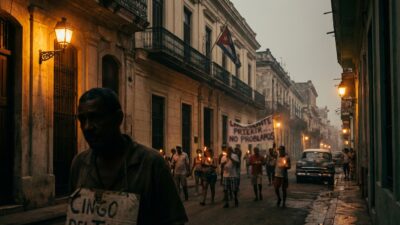
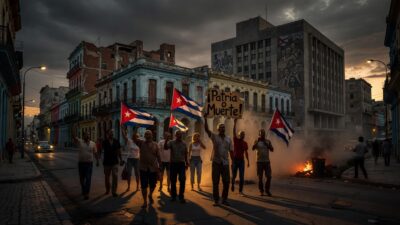
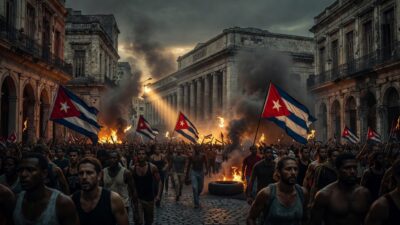
The People in the Streets
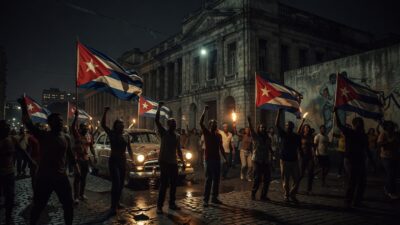
What happened on March 7 at the University of Havana is historic. A group of students staged a protest lasting several hours on campus — something not seen since the 11J demonstrations of 2021. The students demanded an end to class disruptions caused by the blackouts.
But this protest is different from previous ones. It wasn’t a spontaneous eruption in a peripheral neighborhood. It was at the University of Havana — the ideological heart of the regime. When you lose the university students, you lose the narrative.
The Economy: Numbers Don’t Lie
Cuba’s economy has contracted for consecutive years. Real inflation exceeds 300%. The average state worker’s salary — about 4,000 Cuban pesos per month — doesn’t cover a week’s worth of basic groceries.
- Mass migration: Over 500,000 Cubans have fled the island since 2022, according to U.S. CBP data
- Food rationing: The ration book, a relic of the socialist system, no longer covers even minimum needs
- Healthcare collapse: Hospitals lack basic medications, anesthesia, and working equipment
- Paralyzed tourism: The few tourists who arrive find hotels without electricity or running water
Can Díaz-Canel Fall?
Díaz-Canel is not Fidel. He has no charisma, no revolutionary legitimacy, and no repressive apparatus as efficient as the one he inherited from the Castros. What he has is institutional inertia and the increasingly lukewarm support of the Revolutionary Armed Forces.
The problem for the regime is that the FAR are also an economic actor. They control GAESA, the business conglomerate that manages the majority of the island’s tourism and commercial sectors. When GAESA stops being profitable, the generals start making different calculations.
Trump’s offer of a “friendly takeover” and the negotiations led by Marco Rubio add pressure. For the first time, there’s a visible exit — not a perfect transition, but an alternative to the status quo that would benefit virtually everyone except the party’s inner circle.
What Must Happen
From a conservative, pro-liberty perspective, the solution is clear:
- Maintain economic pressure until the regime agrees to negotiate a real transition, not a cosmetic one
- Demand free elections as a condition for any deal — not reforms within the single-party system
- Prepare a reconstruction plan that opens the island to private investment, free trade, and property rights
- Protect the dissidents on the island who are risking everything for their people’s freedom
The Cuban regime has survived 67 years. But it has never been this weak, this isolated, or this close to the end. The question is no longer whether it will fall, but when — and whether the free world will have the will to support the Cuban people when that moment arrives.